旅行、サイクリング、ゴルフ、ダイビング、ドローンなどを勝手気ままに楽しんでいます。フィリピンの企業に勤め、フィリピンで生活しています。
I enjoy traveling, cycling, golf, diving, and drones at will. I am a Japanese, work for a company in the Philippines and live in the Philippines.
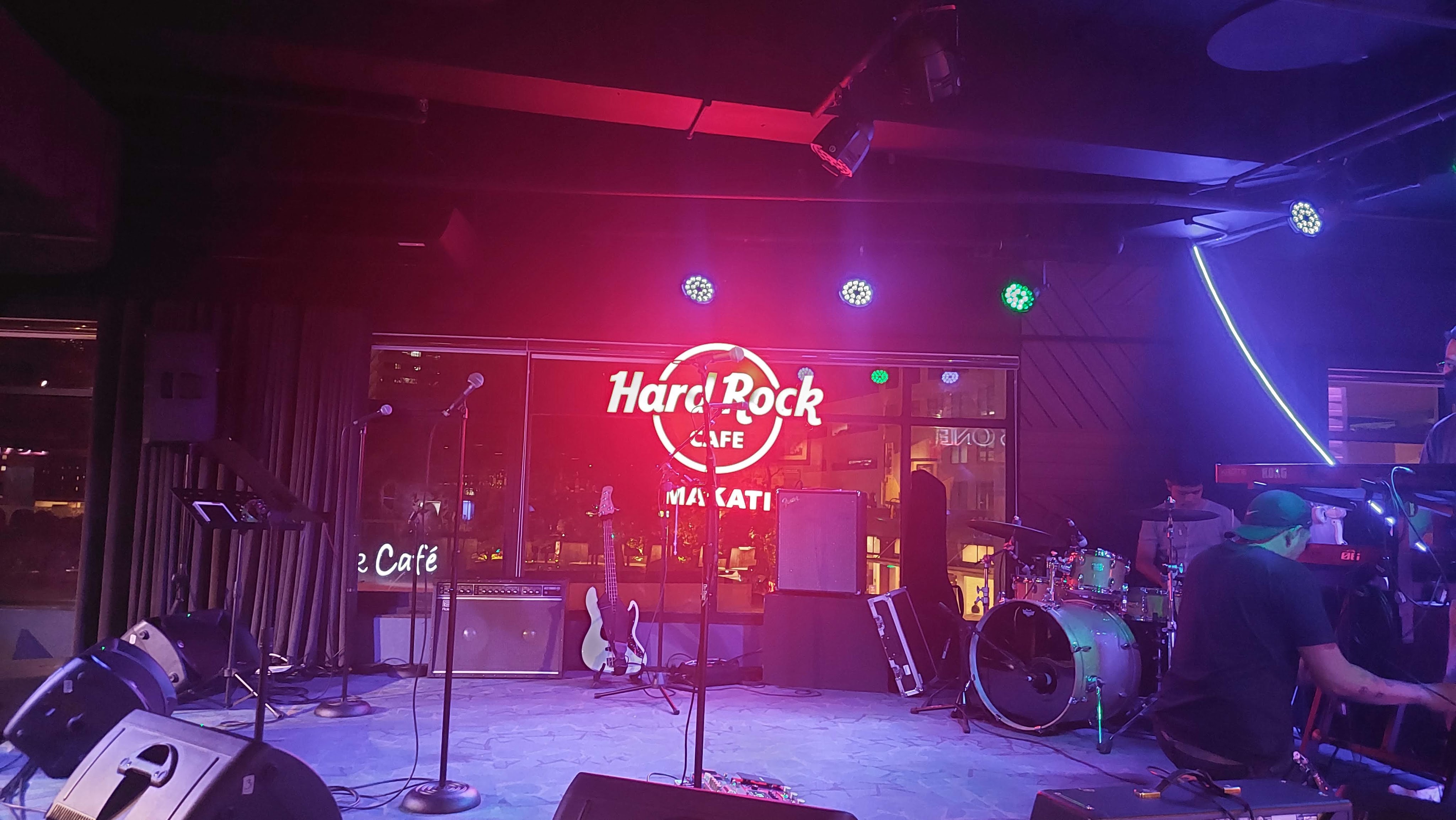
旅に出ると、Hard Rock Cafeを探してしまいます。Tシャツや帽子をついつい買ってしまいますね。後輩はピンバッジを探しているのでお土産にも最適だと思います。
When I travel, I always look for Hard Rock Cafe; I end up buying t-shirts and caps. My colleague is looking for a pin badge, which would make a great souvenir.
フィリピンには”Hard Rock Cafe Makati”と”Hard Rock Cafe Manila”があります。特にMakatiは住んでいるところから徒歩圏内。毎日Liveをやっていることを知ってからは、かなりの頻度で行ってしまいます。実は本日もこの後友達と馳せ参じます。
There are “Hard Rock Cafe Makati” and “Hard Rock Cafe Manila” in the Philippines. Makati in particular is within walking distance from where I live. Since I found out that they have live concerts every night, I have been going there quite often. As a matter of fact, I will go there with my friends later tonight.
The T-shirt pictured above is one of my beloved T-shirts. I had wanted to get one before the Covid19 disaster, but never bought it, the store was closed for a long time due to the Covid19 disaster. I bought it right after the store reopened. I was wondering what I would do if the store did not reopen.
I think the Filipino bands are quite good, and I’m glad to listen to many songs from the 70s, 80s, and 90s.The door charge is 295 pesos (about $5.4, or about 700 yen), which is a very reasonable price since one drink is included. The door charge is 295 pesos (about 5.4 dollars, about 700 yen).
私の最愛の場所の一つHard Rock Cafe Makati、在住の皆さんにも旅行でフィリピンに来る方にも是非お勧めします。海沿いのHard Rock Cafe Manilaにも是非。
I highly recommend Hard Rock Cafe Makati, one of my beloved places, to everyone living and traveling in the Philippines. I also highly recommend Hard Rock Cafe Manila by the sea.
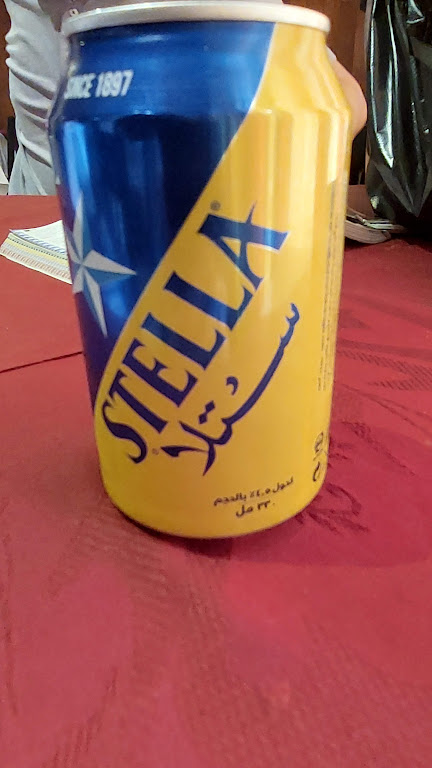
August 12 was a very busy day. We went on an early morning Hot air balloon tour, and after breakfast at the hotel, we visited the Valley of the Kings, Temple of Hatshepsut, and Valley of the Queen on the west bank of Luxor before returning to the hotel. We drank beer at the hotel and refreshed our spirits. We also made a reservation for a high-class French restaurant called “1886” in the hotel, which starts at 9:30 p.m., so it is a very late dinner.
After a quick break, we headed to the Luxor Museum. We knew that the museum was a short distance from the hotel, beyond the Luxor Temple, but there was a road that seemed to be connected but was not, and we never reached our destination. We kept going back and forth along the same road, and by the time we finally arrived at the museum, the sun was setting.
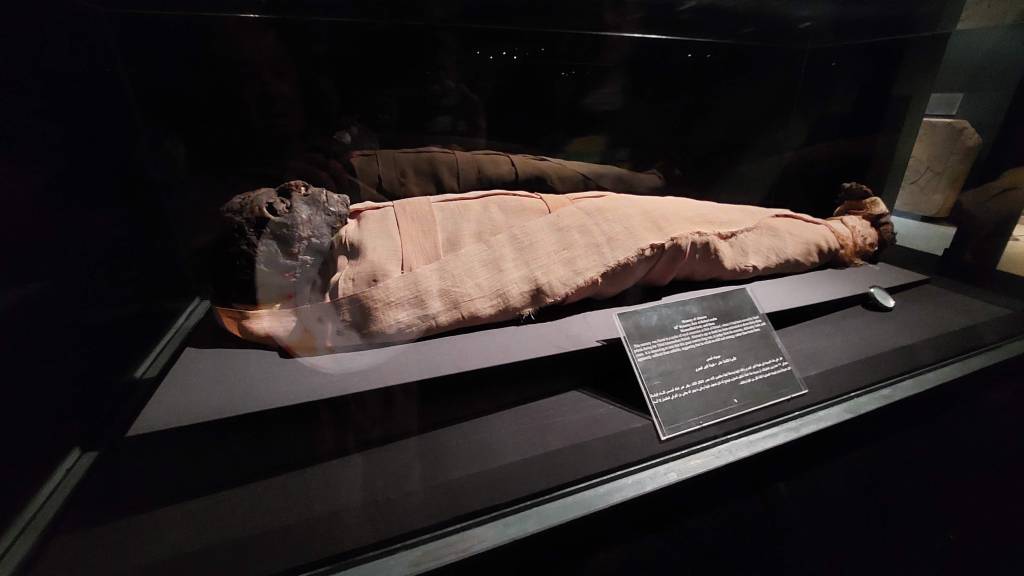
It is a small museum, but it seems to be worth seeing. However, I have not studied the museum well enough in advance, and although I read the explanations, I always end up just saying, “Oh, wow”. As I have written in my blog before, I have been going to museums only when I travel, so there is no way I can suddenly enjoy a museum.
After the museum, we headed to the Luxor Temple. The Luxor Temple and Museum are open until 9:00 p.m. (so says the guidebook), so you can make the most of the late hours.
There is only one entrance to the Luxor Temple, and it is difficult to find, so we walked carefully. We had already walked more than 20,000 steps and were very tired. Then we received a startling revelation. The Luxor Temple was closed. I remember it was only after 8:00 pm. Not willing to give up so easily, we went to the exit. The plan was to try to enter through the exit. But it was not possible. There was an attendant at the exit. We presented our Luxor passes and desperately tried to show them that we didn’t need to buy a ticket.
After the utmost pleading, we were allowed to enter, and only for five minutes. It was a wonderful moment when we truly realized the power of the Luxor Pass. The Luxor Temple was beautifully illuminated and the joy of being allowed special admission made a great impression on me.
When the time came, the lights mercilessly went out and the many remaining tourists were escorted out. Back to the hotel for the acclaimed French cuisine. If you don’t have a tie, you can borrow one. The restaurant is that good. We went without jackets, but the rest of the guests were more dressed up.
All of the food was delicious, and the prices were appropriate, as they should be. We had to check out the next morning, so I cleaned up my room so I wouldn’t forget anything before going to bed.
A car was called for us at 5:50 and we headed to the Temple of Karnak, which opens at 6:00. The early morning was cool and perfect; on the morning of the 12th we had to wait for the start of balloon tour, but on the morning of August 13th the balloons were floating high in the sky by 6:00.
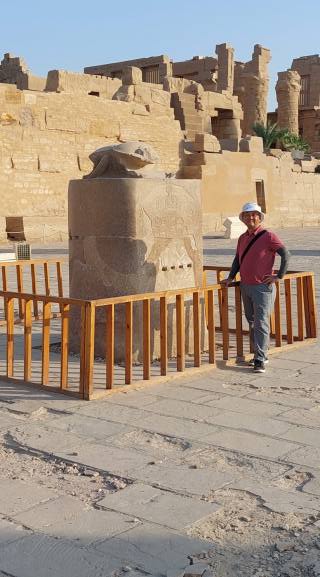
We were the first to arrive at the Temple of Karnak and were treated to a completely different natural light experience than the “Sound and Light Show”. It was a pleasant feeling to have the magnificent temple almost to ourselves. We made seven counterclockwise laps around the “scarab”, so I am sure our wishes will come true. On the night of the 11th, all I could remember was struggling with sleepiness, but this time I truly enjoyed the Temple of Karnak.
We returned to the hotel, had an elegant breakfast, checked out, and headed for Luxor airport. Once in Cairo, a reunion with Mr. F awaited us. We paid the fare, thanking the driver, and said goodbye.
We already felt the heat after landing on the balloon tour, but during the day we would experience the real heat, so we took extra precautions against the heat: dissolving Pocari Sweat powder in water, wearing a hat, wrapping a cool towel around our necks, and sunglasses.
The first thing to do is to go to the” Valley of the Kings” ticket center and purchase a” Luxor Premier Pass”. The driver has been informed of this and we will arrive at the ticket center shortly. We set out for the ticket center, but it seems that the passes are sold in a slightly different place. I had brought my own photos for this purpose, so the purchase went smoothly. However, the staff member was very eager to show us how wonderful the Luxor Premium Pass is and seemed to be demanding a gratuity. We paid the tip (a quite a few amount) and hurried on.
I am not sure if they are guides or just looking for money, but they are always trying to talk to us. I don’t know if they are trying to explain to us that there is a limit to the number of tombs that can be entered with a regular ticket or not, or if they are trying to be our tour guide, we already said that “we do not need your support at all” to avoid any nuisance.
From the reception desk in the Valley of the Kings to the tombs (there are about 60 according to the guidebook), you will ride in a kind of cart. This is not covered by the pass, so we paid the cart fee (5 Egyptian pounds = 35 yen) and got in. The cart can originally hold about 10 people, but the driver took off with only the two of us. I was grateful, but it was his strategy. He said, “It’s an express service. I like Japanese people,” he said and asked for a tip. We paid him a tip higher than the fare.
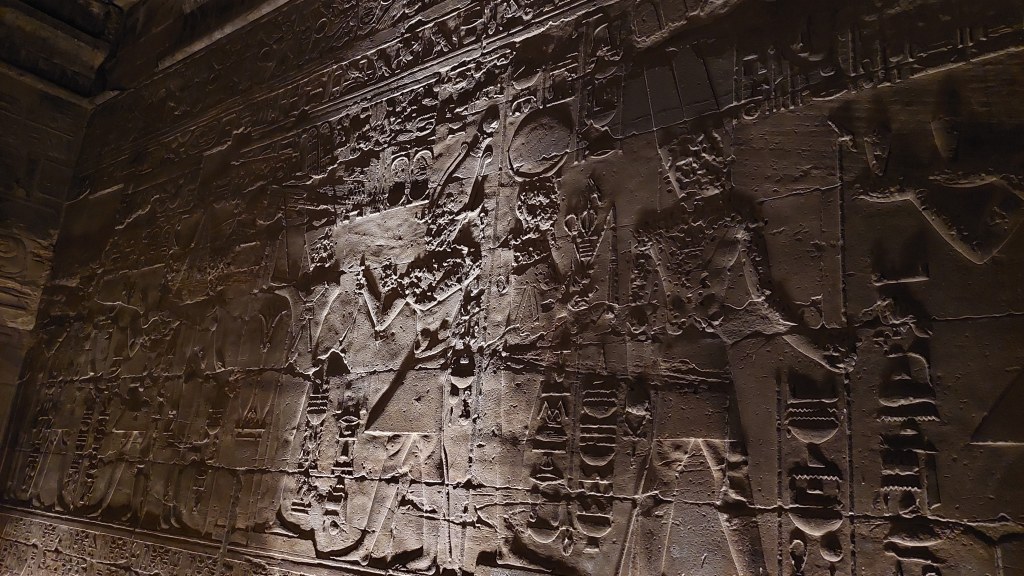
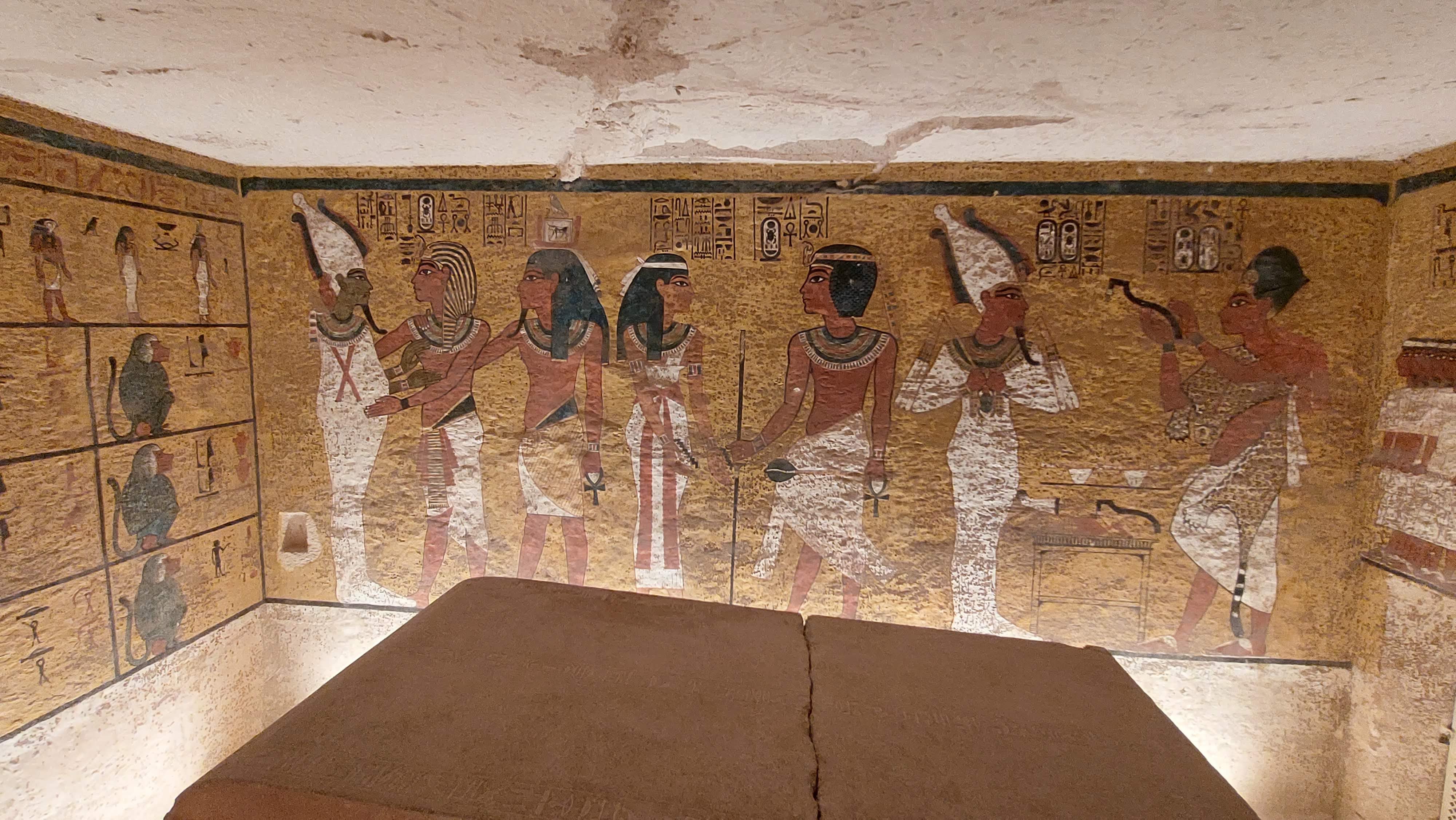
Thus, despite the “tipping attack”, we arrived at the tombs area safely. First, we dive into a nearby tomb. We are surprised to see the well-preserved wall paintings on the walls and ceiling, which must be more than 3,000 years old, and next we go to the famous tomb of Tutankhamen. This too requires a separate payment of 300 Egyptian pounds (2,100 yen), but we simply show our passes. It has been about 100 years since it was said to have made the “great discovery of the century” in 1922. It is very exciting to know that the tomb of a king who died about 3,300 years ago was discovered 3,200 years later.
We then enter the tomb of Ramses I, before the highlight of the Valley of the Kings (by far the most expensive to visit), the tomb of Seti I. We proceed, somewhat accustomed to the unique smell and air of the tomb.
Finally, the tomb of Seti I. Show our Premium Pass and log in the notebook before entering. It is a large tomb and the path to the tomb is obviously longer than the others. The colorful mural paintings are different from the previous tombs. Perhaps because of the high price, there was no one else there but us, so we could take pictures without hesitation.
Inside, there is a man who seems to have been waiting for us and starts guiding us on his own. I thought, “we have to pay a tip, and we have no choice” and listened to his explanation, and it was valuable. He also moves the fence to let us in.
After seeing the impressive tomb of Seti I, we took a short rest in a sort of kiosk and left the Valley of the Kings. We took a cart on the way back, but this time we sat farther away from the driver and did not ask for a tip. I began to get the tips of it.
We drove next to Queen Hatshepsut’s Funerary Temple. It is a magnificent temple built in front of the rocky mountain behind it, and it is truly amazing. To be honest, however, I was not so impressed compared with the numerous murals. The view of the greenery and desert from the Funerary Temple left a strong impression on me.
After a great breakfast at the hotel, we were not particularly hungry and continued our sightseeing without lunch. Next stop was the Valley of the Queens, where Nefertari’s tomb is located.
He asked us if I could drop in on a very high quality workshop run by an acquaintance of his. Since we were indebted to him, we complied, even though we thought it was a bit disreputable. The place he took us was a souvenir shop like we had expected, and it looked like we had to buy something. I bought a small pyramid, thinking that I was going to buy a souvenir anyway. Again, I was asked for a tip, and I paid some. The owner of the store did not seem very satisfied and did not seem to give the driver a good impression.
I have not been in Egypt long enough to talk about it, nor have I researched it thoroughly, but I got the unfortunate impression that souvenirs in Egypt are poor, poorly made, and overpriced. At tourist spots, I saw so many people trying to sell their junk, saying “1 Dollar, 1 Dollar”. I didn’t see anyone buying.
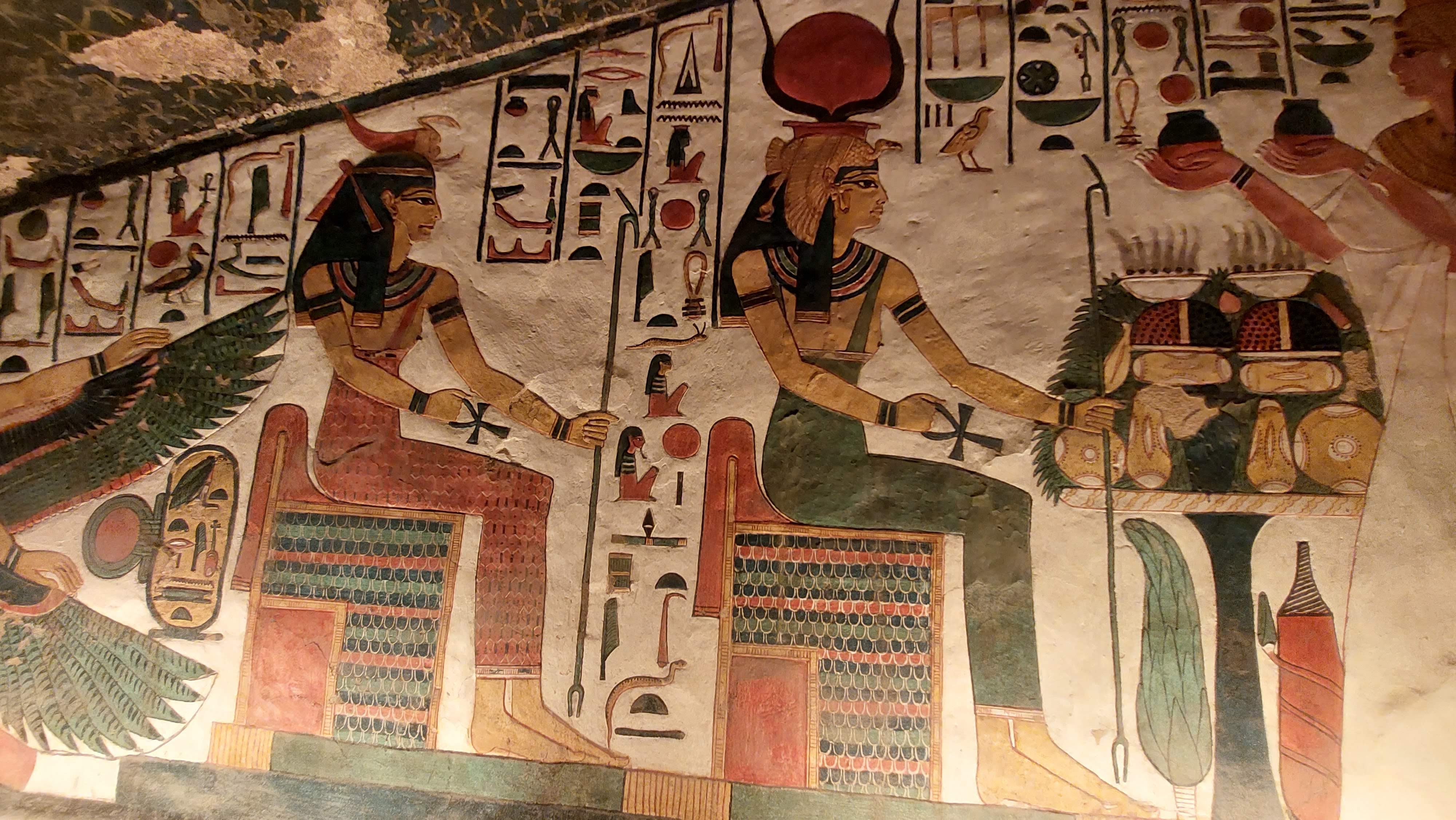
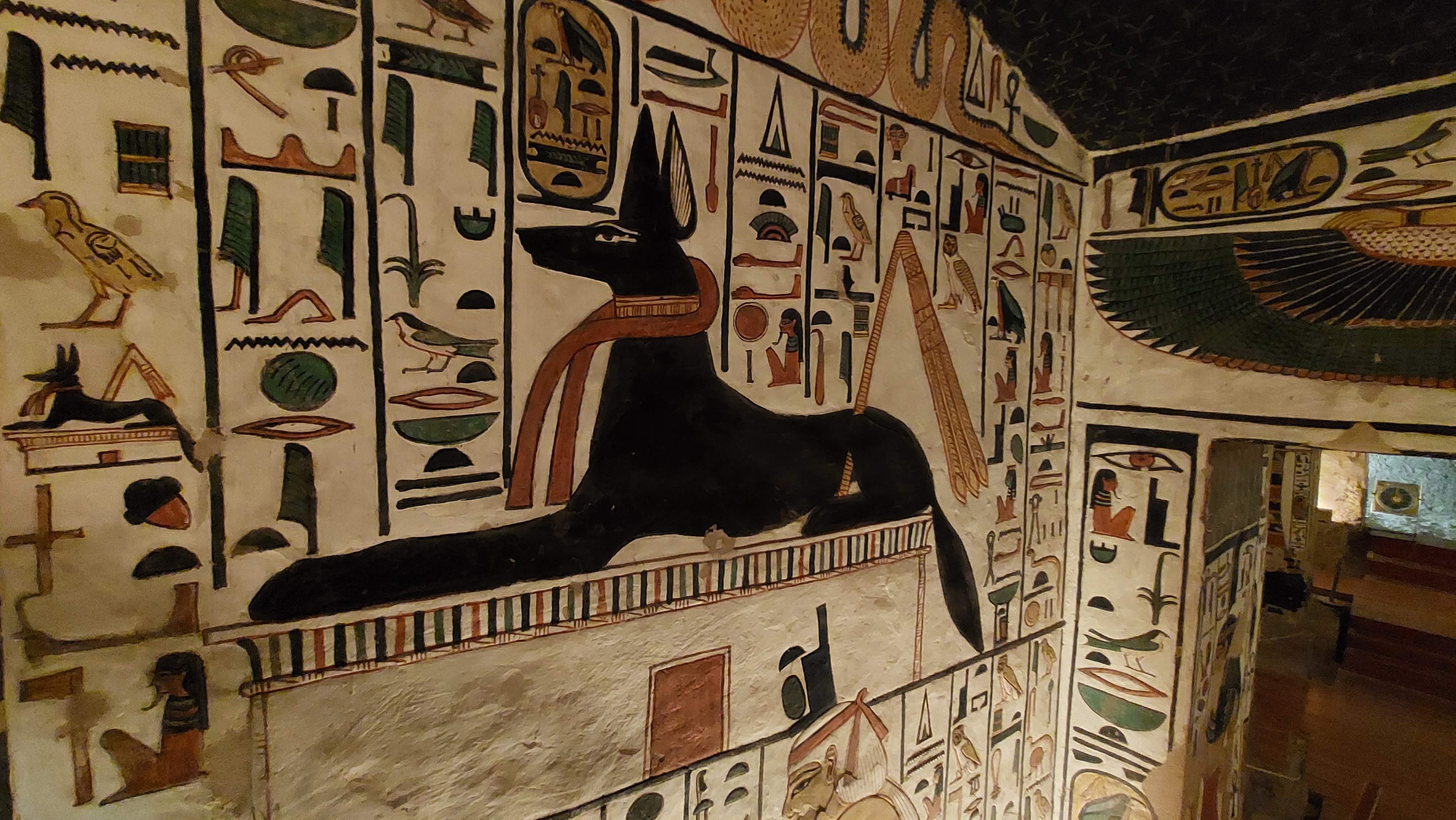
After fulfilling our duty to the driver, we went to Nefertari’s tomb in the “Valley of the Queens”. Compared to the Valley of the Kings, the Valley of the Queens was less crowded. We showed our passes and headed for Nefertari’s tomb. Again, we recorded the information in a log and felt the difference from the ordinary tombs. This is a tomb that demands a tremendously high fee of 1,400 Egyptian pounds (about 9,800 yen). Also, only 10 minutes of sightseeing is allowed. I remember that the inside of the tomb was not as big as the tomb of Seti I, but the colors of the wall paintings are wonderful. According to my research, this tomb was discovered in 1904, so it was only found 118 years ago. As is true of all the tombs, it is amazing that the murals, which are more than 3,000 years old, have remained so vividly preserved. Among them, I remember that the tomb of Nefertari and that of Seti I were exceptional.
Impressed by the beautiful tombs, we left the Valley of the Queens. The Colossus of Nemnon is only for photography. We returned to the hotel. We had a beer at the hotel and rested for a while.
It took about 13 hours to arrive at Luxor by plane, 21 hours including connections, etc. On 11th August, the first day in Luxor, we only enjoyed the “Sound and Light Show” at the Karnak Temple and very tasty Egyptian food and beer. We spent the rest of the day making travel arrangements. The highlight of our Luxor sightseeing tour will be on August 12.
As previously mentioned, the Hot Air Balloon tour will arrive at the hotel at 3:30 AM, so I set my alarm at 3:15 AM. I know that if I set it too early, I will feel relieved and fall asleep again. I was that nervous.
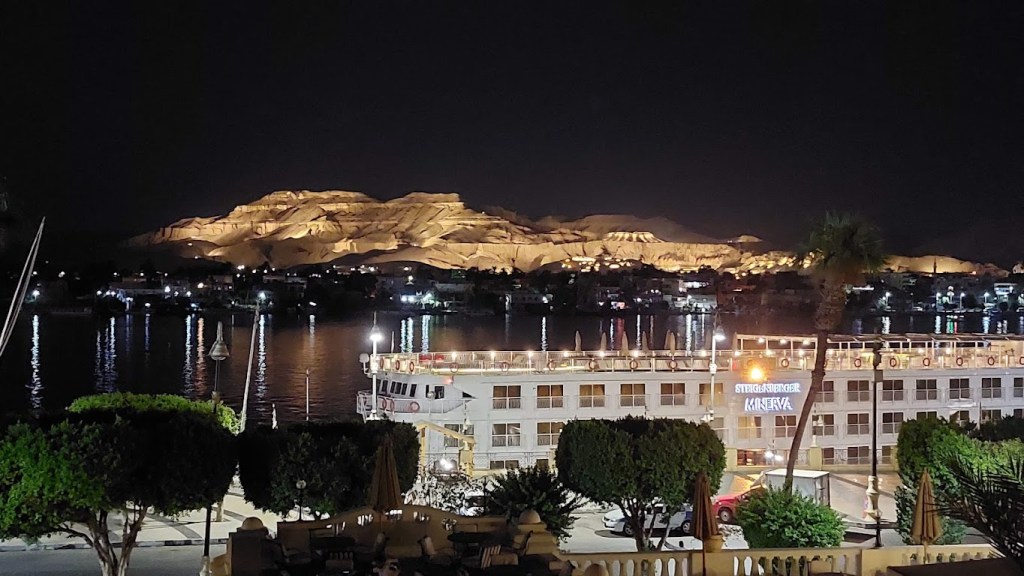
Woke up on time and exchanged texts with Mr. O. Traveling by two is convenient in many ways. The person picking us up is also at the hotel punctually. The view from the hotel, the cruise ship, the Nile River, and the lights on the west bank of the Nile River, look so great.
We met up with the people staying on the Nile River cruise ship and others. We were all ready to go, admiring our names on the list, noting our weight (necessary for balloon balance) and so on.
ナイル川を小舟で渡るときには何とも言えない感動。
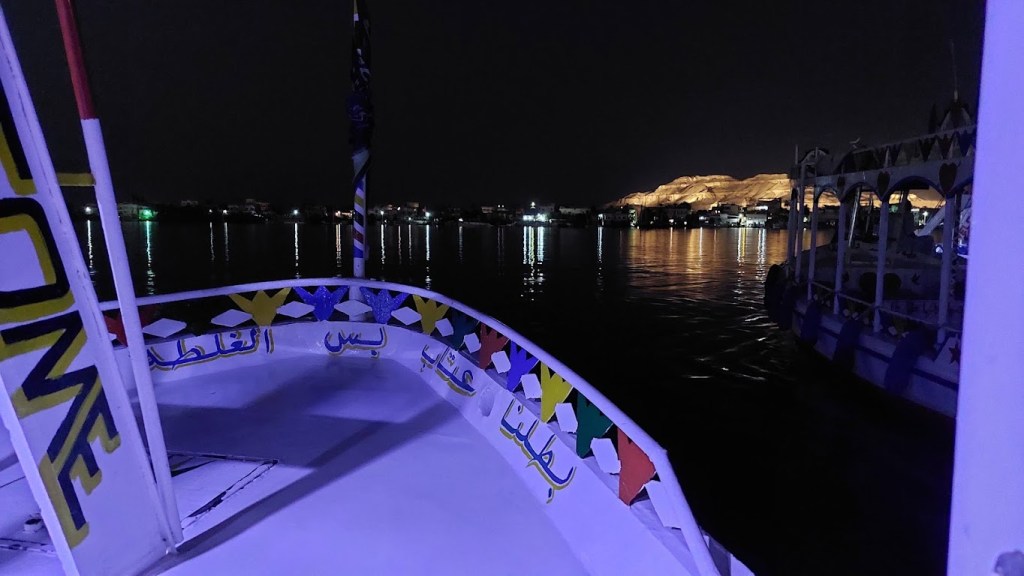
It was an indescribable feeling when crossing the Nile River in a small boat.
In Japan, people tend to call everything “the world’s three major XXX. Among Japanese people, the world’s three major rivers seem to be the Nile, the Amazon, and the Mississippi. In my opinion, the Amazon and the Nile are the two greatest rivers in the world, boasting the world’s second longest river (6516 km) and the largest river basin area (7.05 million km2). The historical and geographical importance of the Nile River, which has brought civilization, greenery, and water to Egypt, is exceptional, and I feel that it is competing with the Amazon River for the top spot.
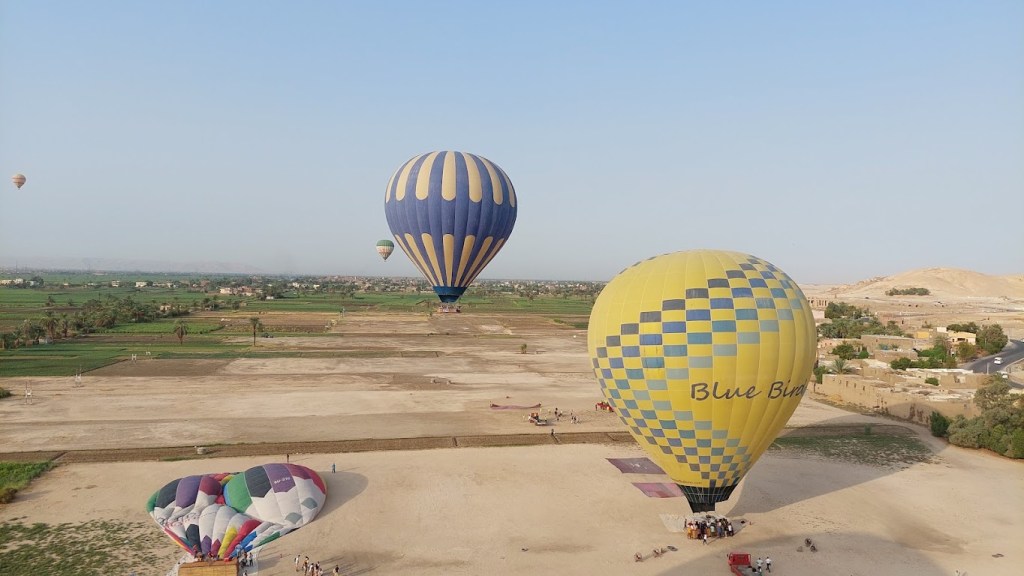
I arrived at the other side of the river (west bank of the Nile), completely no sleepy anymore. A microbus was waiting to pick us up and take us to the square where the hot air balloons would depart. There seemed to be a variety of travel agencies, but there seemed to be only one place for the balloon departures. Quite a lot people (about 800, I guess) had gathered. It seems that it is normal for 25 people to ride in a balloon. The balloon before being inflated with air is lying on the square.
Well, we arrived at the ballooning station, and while we were being explained, the sky gradually began to lighten up. Since we were going to watch the sunrise from a balloon, we decided to depart at that time. However, the balloon ride did not start. The guide told us that the wind was a little strong and they were waiting for the wind conditions to improve. I was not sure the wind condition in the sky, but on the ground, it was far from strong winds. Little by little, I felt impatient.
I understand that Hot Air balloon is a dangerous ride because heavily depending on winds, but the sun was coming up and I was getting impatient. We had waited for more than a hour.
The wait is getting longer, and the locals are singing and dancing while clapping tambourines and other instruments, whether to pass the time or to entertain the audience. Some of the visitors also join in and make a lot of noise. However, I was not in the mood to enjoy such music and dancing at all, and was muttering something like, “If we can’t fly on this level of wind, A lot of Hot Air Balloon Tours would be canceled, and the travel agency would suffer from refund.
It was already past 6am. After our balloon tour, we will enjoy an elegant breakfast at the hotel, and the “second day of Luxor Tour” is about to begin. If it gets too hot, we may not be able to do any sightseeing. My impatience reached a considerable level.
That moment. A rather small man wearing an outfit somewhere between yellow and orange, the kind that only high position officers are allowed to wear, came running out of the building and circled his hands (like an educational instruction in judo). The surrounding area was filled with cheers and a sudden flurry of activity.
Our Hot Air Balloon tour was given permission to begin. I am now old enough, but the joy I felt at that time was as pure as the joy I experienced as a boy.
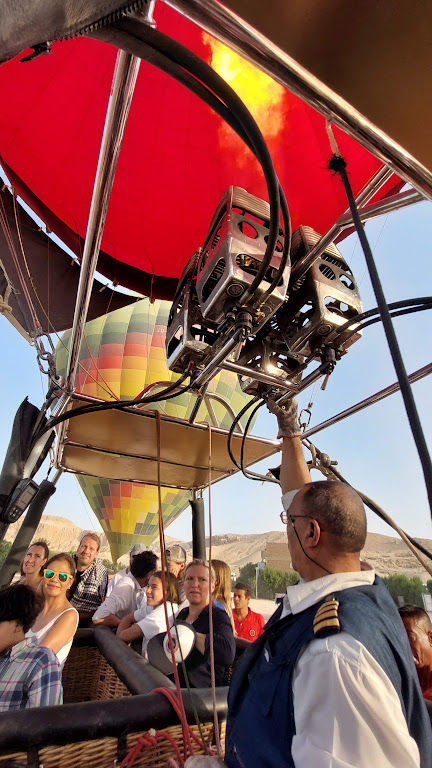
A large fan was used to blow air into the balloons, which had been lying flat on the ground. When the balloon was inflated to a certain degree, a huge gas burner was used to heat the balloon, and it began to float little by little. Then the gondola part was brought in, people got on board, and the balloon took off.
我々の気球も準備開始。いよいよ乗り込みます。中ではキャプテンがガスを気球に送り込みます。
Our balloon was getting ready. Finally, we were getting into the balloon. Inside, the captain blew gas into the balloon.
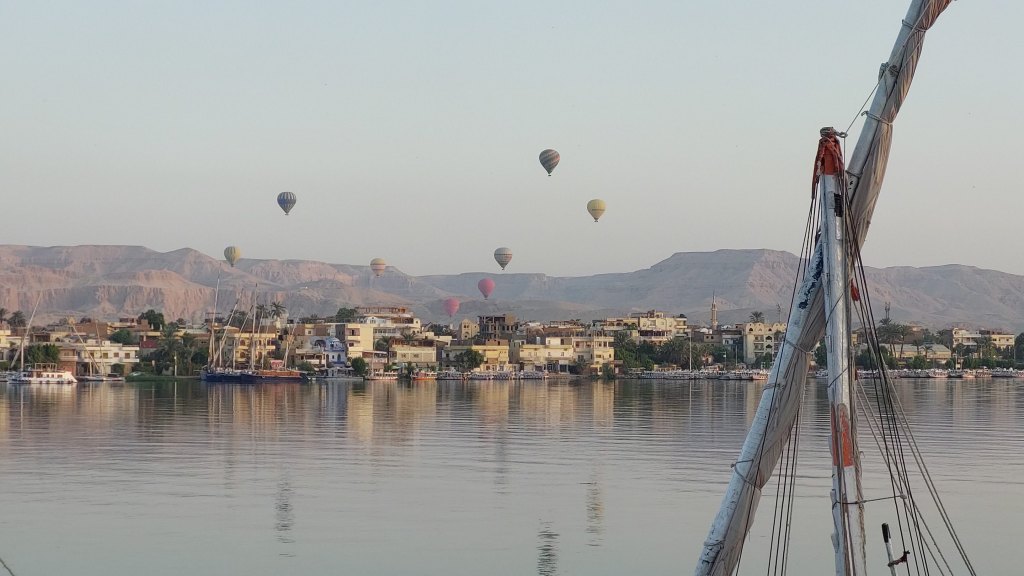
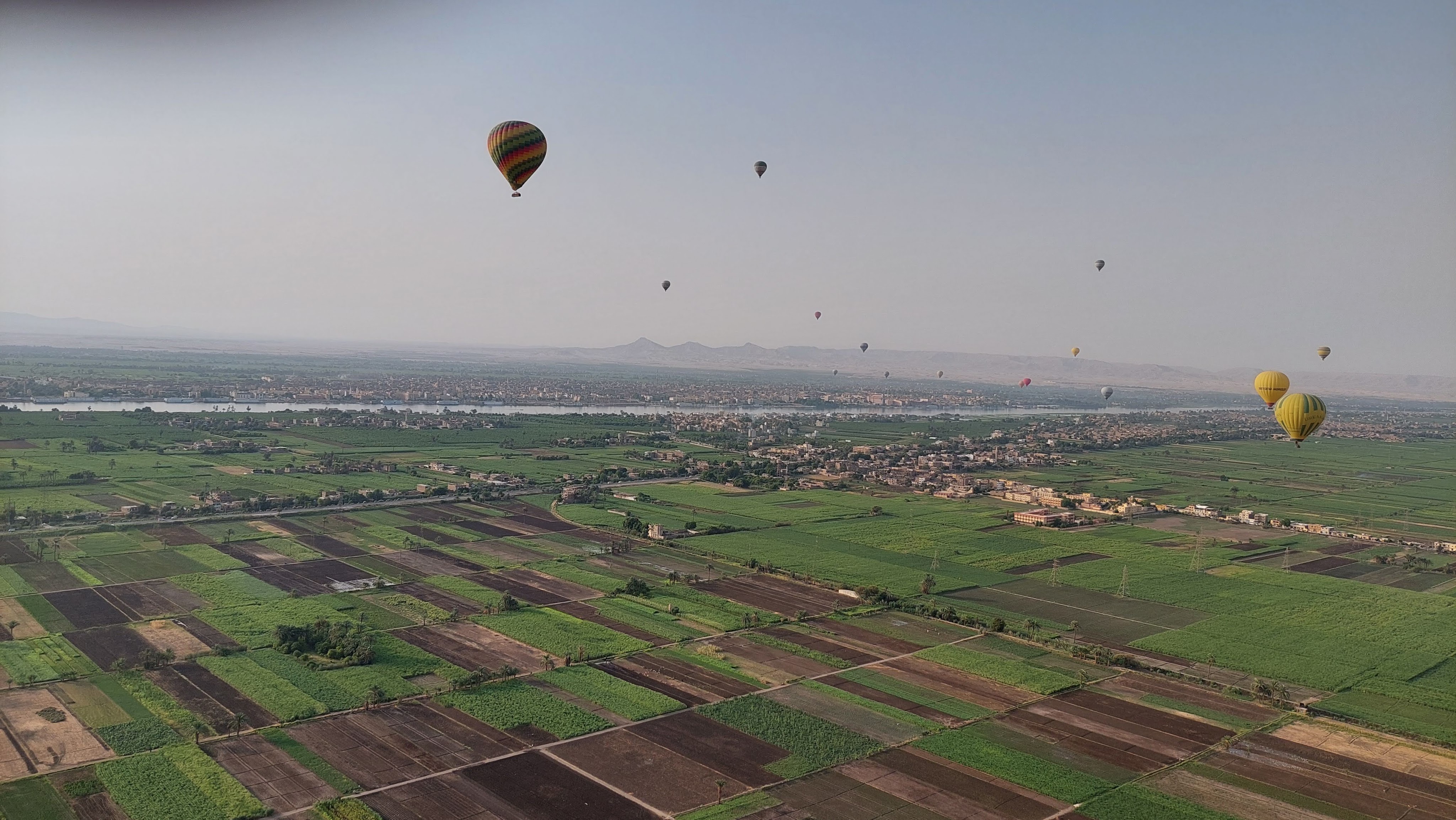
The long-awaited takeoff was underway, and my first balloon ride of my life began. The balloon itself seemed to be able to rise and fall with heat and to turn around using the holes in the balloon. I was impressed by the captain’s skill when the balloon slowly circled in the sky.
We crossed the Nile River from the west bank to the east bank. The balloons seemed to fly depending on the direction of the wind when they took off, but quite a few of them were flying over the east bank as we were. The captain did not want to be carried away by the wind, so he lowered the altitude. The balloon passed over the houses where people were living. The residents were accustomed to this and waved to us in hospitality.
Now, it was time to land. The captain carefully chose a landing spot and gradually lowered the altitude. We were instructed to take landing position and wait for the landing. Finally, we landed. The gondola shook so much that we thought it might overturn. A woman nearby screamed loudly. The captain shouted, “Don’t worry,” and we landed safely.
マイクロバスが着陸地点に到着、ホテルへ戻りました。感動の気球ツアーが成功裡に終了しました。
A microbus arrived at the landing site and returned to the hotel. The impressive balloon tour ended successfully.
I started the Balloon Tour early in the morning without any protection from the heat or the sun, so while waiting for the bus at the landing point, I was struck by the heat and the intensity of the sun. We had to be always prepared for the heat and the sun.
After we made a slight delay in the 9:00 a.m. pickup and a slightly in a hurry of breakfast (of course, we didn’t rush through a five-star hotel breakfast), the sightseeing in Luxor was in full swing.
After meeting up with Mr. O, we had some time before our 12:45 flight, so we had tea in the airport and finalized our itinerary, etc. However, even at around 12:15, there was no sign of boarding starting. Would it end up being the original 13:15? The flight was delayed even more than that. The takeoff was finally around 14:00.
I am not in the habit of looking at the scenery from the plane, but on the flight from Cairo to Luxor, I was surprised at how desolate the landscape was. As far as the eye could see, there was desert, no sign of human habitation, and not a tree in sight. Needless to say, without water, humans and other living things cannot survive.
As the city of Luxor came into view and the fields and buildings along the Nile River came into view, the famous saying “Egypt is the gift of the Nile” was truly realized. The delay was disgusting, but the scenery from the window made the flight memorable.
Well, we finally arrived in Luxor. We had decided to take a cab to the hotel, but the first obstacle, negotiating with the cab driver, awaited us. According to the guidebook, the fare from the airport to the hotel (city center) is 150 Egyptian pounds (1 pound is about 7 yen, so about 1,000 yen), but, well, we weren’t going to negotiate that close to the limit. A cab driver, who seemed to be in jokey, approached us. At first, he said the price was too much, so we told him that we would negotiate with another cab driver. He then softened his attitude. Negotiations were concluded at a price we could agree on.
We had decided to charter a car for tomorrow’s Luxor sightseeing tour, and we were able to negotiate a half-day tour at 500 pounds (approx. 3,500 yen). We told him that we also wanted to go hot air balloon in the very early morning, which he was willing to arrange, and he agreed to take us to a balloon tour company that he was familiar with.
We had just met him and there were unknowns as to whether we could trust him, but after discussing it with Mr. O, we concluded that there would be no advantage in him deceiving us, so we went to a balloon tour company in an off-street. The store was far from respectable, but we concluded that we should trust this one too. The price was 500 Egyptian pounds, it may not be the cheapest, but I can say for certain that it was a well-run tour company at a reasonable price. According to the guidebook, the price changes depend on the season.
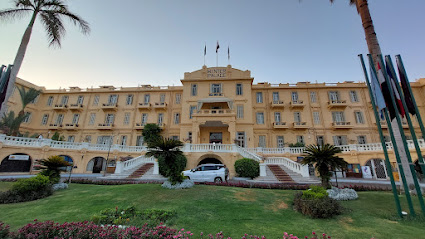
With tomorrow’s taxi arrangements secured, I finished signing up for the balloon tour and finally arrived at the “Winter Palace Hotel,” one of the three major hotels in Egypt. The Nail View room was the right choice for me.
A little later, I headed to Karnak Temple to buy “Luxor Premium Pass”. Karnak Temple is supposed to close at 5PM, so we figured we would somehow get there in time. We used a different cab driver than the one who came to the hotel from the airport to take me to Karnak Palace.
I remember that we arrived at the Karnak Temple around 4:30PM, but the attendant told us that it was already Closed. We had to take into account that the description in the guidebook was incorrect. However, we decided to go to the entrance to get a taste of the atmosphere. The Karnak Temple is very powerful, but it is not as powerful and impressive as it is when seen in a place where you do not pay an admission fee.
The cab is waiting for us because we had negotiated a round trip. However, the cab driver kept trying to increase the cab fare by making various suggestions. We were probably very suspicious of this taxi driver on our first day of sightseeing in Egypt, but now we are glad that we did not use him as our main taxi driver.
We went to a restaurant “Jamboree”, which the guidebook recommended. We were attracted by the phrase, “Unusually for a restaurant in the Souk, they serve beer, wine, and other alcoholic beverages,” and by the restaurant’s “middle class” rating, but they did not have any beer. The description in the guidebook may not have been updated in time.
As we really wanted to drink beer, we asked the waiter if we could buy beer, and it seemed that beer was sold nearby. After leaving the restaurant, I asked further and got our long-awaited beer.
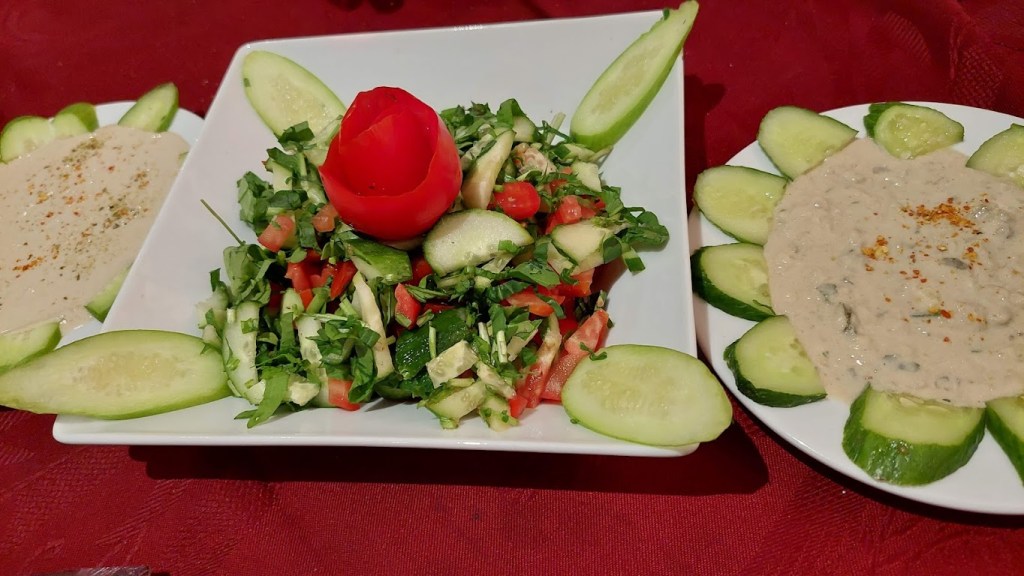
The food was really good, with a good balance of meat and vegetables and spices. However, I don’t think I would have been able to reach that level of satisfaction at all without beer.
Having failed to obtain the Luxor Premium Pass, we decided to go to the “Sound and Light Show” at Karnak Temple, which is not covered by the Premium Pass, instead of the Luxor Museum and Luxor Temple.
Since we had received a phone number, we contacted the driver who took us from the airport to the hotel and he came to pick me up. We entered the Karnak Palace, which I had longed to see, with 300-pound entrance fee. The illuminated Karnak Temple was very impressive. However, as soon as we were seated in the auditorium overlooking the “Sacred Pond” with a view of the West Bank in the distance, we felt a strong urge to sleep. Mr. O also said that he could not overcome the sleepiness.
こうして、いろいろあったルクソール観光1日目が終了しました。
Thus ended the first day of sightseeing in Luxor, which had a lot going on.
明日は早朝気球ツアー。3時15分起床というなかなか緊張感のある旅程です。
Tomorrow is an early morning balloon tour, a nervous itinerary with a 3:15 a.m. wake-up time.
I omitted to mention this in the last blog. The itinerary for the Luxor trip was definitely going to be very busy, even if we were able to catch the 13:15 flight or the 18:00 flight. Especially if we take a hot air balloon ride, because we never know when we can start sightseeing. So, we decided not to decide in advance whether or not to take the balloon ride, but to decide after we arrived in Luxor.
One of the highlights in Luxor is a visit to the tombs in the “Valley of the Kings” and “Valley of the Queens”. The “Tomb of Seti I” and “Tomb of Nefertari” alone will cost you USD52 and USD74, one of the highest entrance fees in the world, I think. Considering that we are going to Luxor and there is a high possibility that we will never go back, it would be better to see them. We also decided to buy the Luxor Premium Pass because we would not have the time to find the ticket booths and stand in line every time. 200 dollars is a lot of money, but with it, we can visit most of the tourist sites in Luxor for five days just by showing the pass. The only exception is the “Sound and Light Show” at the Temple of Karnak. This requires an entrance fee of 300 Egyptian pounds.
8月10日の仕事を終え、荷造りの最終チェックをし、いよいよ、旅の開始です。
After the job of 10th August, final check of belongings, finally Egypt tour started.
I had a hard time deciding where to eat dinner, but I started our trip with our favorite “pressed mackerel sushi” and “tempura set” at Akitaya, and of course, a beer.
The airport was not particularly crowded, and the 8-hour flight from Manila to Dubai was nothing special. In Dubai, I had about 4 hours to kill, but I was not particularly bored while listening to rakugo on Youtube, and it was a 4-hour flight from Dubai to Cairo. The flight departed almost on time, so I would not miss the domestic flight to Cairo, I wondered if Mr. O’s flight would be ok.
As I got off the plane and was moving through the airport (Terminal 2), there were officers saying something about Yellow Fever. Of course, I had printed out the vaccine certificate for Covid 19, but yellow fever is not mentioned in any way in the Travel Guide. I should have told them I was Japanese, but I told them I was from the Philippines, so maybe there was something wrong. I was surprised but managed to walk past there. I still wonder what the rules were, as some people were just as pouty as I was, while others had yellow fever vaccine certificates.
Follow the route in order. Although the airport is not very well guided, I found that the place to pay for the VISA is at the bank on the right side of the immigration line, down a slightly steep escalator. I purchased my VISA there and waited for immigration.
After immigration, I also exchanged money in the baggage area. Following the advice that USD or Euro are advantageous to exchange in Egypt, I changed Euros to Egyptian pounds. I was going to buy a SIM card for my cell phone here, but since I could use roaming, I did not buy a SIM card.
Customs is basically like putting your luggage through a security machine. It is a little confusing. It wasn’t like people who don’t have anything to declare usually just walk right through.
After completing immigration, we finally moved to Terminal 3 for our connecting flight. I knew that Terminals 2 and 3 were close to each other, but I could not find Terminal 3 immediately after exiting Terminal 2. There was no signage at all.
I was told that ”it’s right out of the exit and to the left”, but that’s not clear enough. I was already being asked to take a cab. If I tried to ask a question, I would have been told something inappropriate and made to take a cab.
I asked a traveler for directions, and I was lucky because he was polite and helpful. Take the exit of Terminal 2, go a little to the right, and the terminal is on our left. You will see a building with a slanting pillar-like structure.
The 13:15 flight was changed to 12:45 at the last minute, and we thought this 30 minute difference was significant, but we still made it in time. The immigration process at Cairo airport was very smooth.
Mr. O asked me how to get from Terminal 2 to Terminal 3. Thinking, “Well, you don’t know how to get there,” I texted him about the route I had just taken. I was able to meet Mr. O at Terminal 3 in Cairo without incident.
Religion is a very difficult subject to talk about, but today we will talk a little about the “Religion Yearbook” published by the Agency for Cultural Affairs. The Religion Yearbook is a large work of over 200 pages and is published annually. Part 1, “Overview of Japanese Religions,” is like a review of what you have learned in Japanese history, including the origins and outlines of each representative religion such as Shintoism, Buddhism, and Christianity. It is very well organized, and I think that just by learning this, you will be able to say that you know more about religion than the average Japanese person.
The second section, “Religious Statistics,” and the third section, “List of Religious Organizations,” are full of data and names of organizations. The list of religious organizations includes representatives and addresses, and I think it is quite valuable as a database. Of course, the “Family Federation for World Peace and Unification,” which is currently causing a stir in Japan, is also on the list of organizations.
I think that only those who have seen this yearbook or other data know how many religious corporations there are in Japan. In the category of religious corporations, there are as many as 180,000. There are also about 400 umbrella religious organizations, which are comprehensive groups of religious sects and denominations.
I myself am a Shingon Buddhist, but I don’t spend more than 10 minutes a year on religious activities (I do visit shrines/temples on New Year’s Days, but I don’t consider it a religious activity), nor do I spend any money at all. This seems to be extremely rare in the world. This is just my feeling, but I don’t think most Japanese spend time or money on religious activities.
I will not discuss the merits or demerits of religion, as it is up to the individual to decide what and how to believe or not to believe, but I thought that the Japanese view of religion is quite unique in the world.
In the recent House of Councillors election, the number of seats required for “constitutional revision” was also discussed. Needless to say, the Constitution forms the basis of the nation, so I think it would be good if it were discussed a lot.
The Constitution of Japan was promulgated on November 3, 1946, the year after the defeat of World War II, and came into force six months later on May 3, 1947. In the 75 years since, nothing has changed. I don’t know anything about the constitutions of the world, but it is very rare for a country where the constitution has not changed for 75 years.
The text is old. The words “行ふ” and “ゐる” are written in the old style, and the sentences are difficult to understand. In my opinion, it is nothing but negligence not to take care of these things.
Articles 1 through 8 of Chapter 1 are about the Emperor, because after World War II, how to treat the Emperor became the most important key point. Order is an important thing. I feel uncomfortable that the emperor is stipulated before the contents such as the fundamental human rights of the people.
It is established that the Emperor is treated as a symbol now, and no one disputes this. I believe that the situation cannot be the same anymore as it was from the Manchurian Incident in 1931 to the end of the war in 1945.
日本も変化している訳だから憲法を見直す議論は当然だと思う。
Japan is also changing, so I think it is natural to discuss reviewing the Constitution.
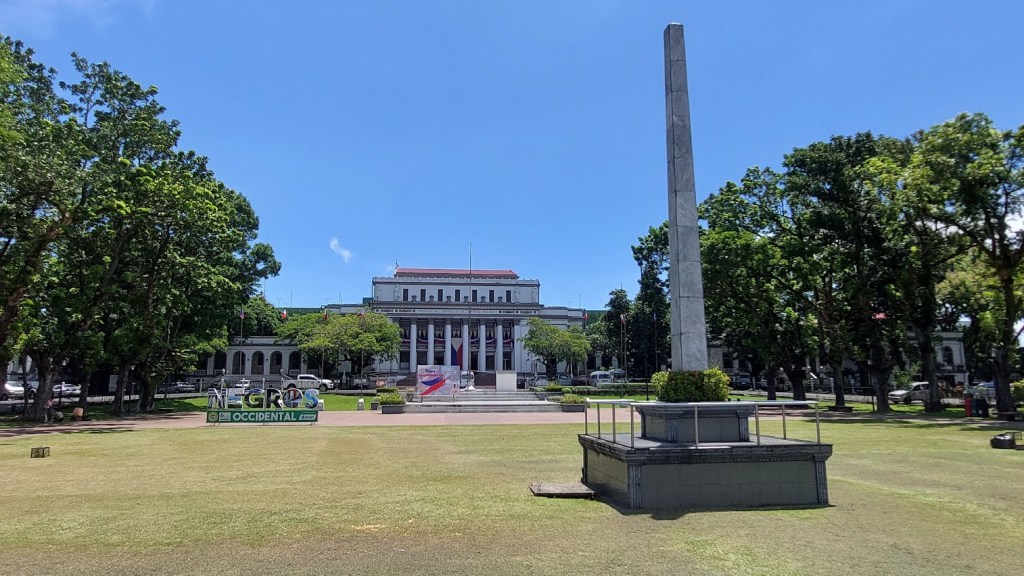
バコロドは、ネグロス島の西ネグロス州の州都です。古くからサトウキビ栽培で栄えた歴史があり、City of Smilesとの別名があるようです。私の中では、イロイロ、ドゥマゲッティと並び「住みやすい街」という印象があります。セブは今や英語留学で有名ですが、バコロドでも英語留学をしている人が居るようです。
Bacolod is the capital of the Negros Occidental in Negros Island. It has a long history of flourishing in sugarcane cultivation and is also known as the City of Smiles. In my opinion, it is one of the “Best cities to live” along with Iloilo and Dumaguete. Cebu is now famous for English study abroad programs, and it seems that there are people studying English in Bacolod as well.
I had the impression that it was a moderately prosperous city rather than a city with special tourist resources. Bacolod is also famous for its “delicious chicken,” so I planned to eat as much chicken as we could!
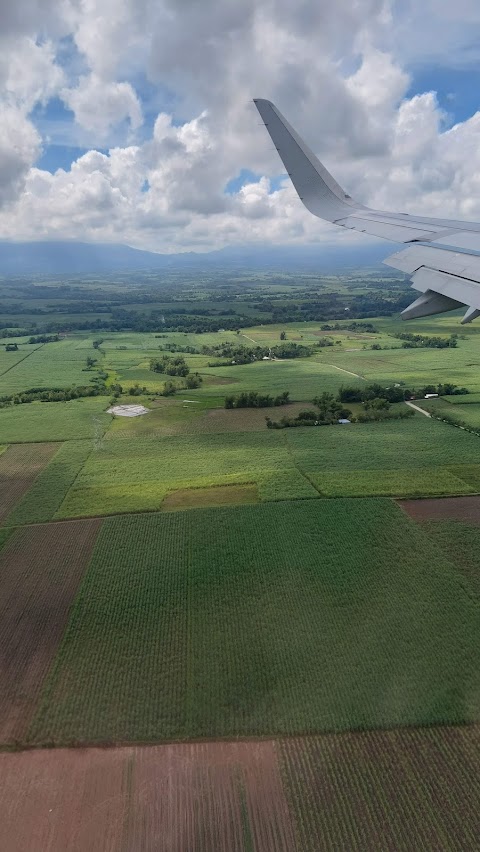
The 8:40 a.m. flight was right on time. Bacolod International Airport is surrounded by sugar cane fields and is full of Bacolod-ness. The atmosphere of the airport is wonderful and promising.
Take a taxi to the center of the city. We will be driving through sugarcane fields. There really are only sugarcane fields. Sugarcane can be grown anywhere in the Philippines, but why are there so many sugarcane fields in Bacolod? Is there an economy of scale? Is it more profitable than other agricultural products such as rice?
I planned to stay at an Airbnb condo for one night, but since I couldn’t check in yet, I spent some time in the center of the city. I had an early lunch of chicken, of course, beer is a must. After that, I just walked around to get a feel for the city. I drank beer, the weather was sunny, and I were very sweaty, but it felt good.
As you walk, you will come across churches, city halls, and other tourist attractions. I walked and walked anyway and arrived at the condo where I stayed. After resting a little, it was time for dinner. Bacolod is close to the sea, so the seafood looks delicious.
Grouper, chicken and beer, a very satisfying dinner. After dinner, we ended the first day with a few drinks at a place where young people gather. I drank a lot of beer, by the way.
I had no particular plans for the second day. Early lunch at a restaurant near the condo. Of course, it was chicken. I usually eat only chicken thighs, but the chicken breast was also delicious. On the second day, I kept walking around.
The Ruinsは私が思うに、バコロド最大の観光名所。車を使わなくては行けないのでThe Ruinsには車で。今回の旅行で唯一、入場料を支払いました。P120 は大変お値打ちだと思います。本当はもっと大きな大邸宅だったそうですが、戦争でかなり焼けてしまったようです。
The Ruins is, in my opinion, the biggest tourist attraction in Bacolod. I have to use a car to get there, so I used a Grab taxi to The Ruins. It was the only place on my trip where I paid an admission fee of P120, which I think is a very good value. I heard that it was actually a bigger mansion, but it was burnt down during the World War Ⅱ
A colleague informed me that I should try a beef soup called Cansi, so I tried Cansi for dinner. It seems to be characterized by large bones. It was a very tasty soup.
一泊二日のバコロドの旅は無事に終了。短い滞在でCity of Smilesを実感できなかったのは残念でしたが、来てみたかったバコロドを満喫することが出来ました。もう一回訪問したいですね。コンドミニアムが多数建設中でしたから次回行った際には景色が変わってしまっているかもしれませんね。
Two-day and one-night trip to Bacolod ended successfully. It was a pity that I could not feel the City of Smiles during my short stay, but I was able to enjoy Bacolod to the fullest. I would like to visit again. There were many condominiums under construction, so the scenery may have changed the next time I visit.
In the last blog I focused on our visit to Apo Island, just outside of Dumaguete. Today, I report on a one-day trip from Dumaguete to the southern part of Cebu, by car and ferry.
このOne Day Tripも宿泊したSea Dream Resortに全てお願いしました。この日は最終日で、15:30にマニラ行のフライトが控えていたこともあり、早朝4:00にチェックアウトし、そのまま空港に向かう旅程です。フィリピンでは少しRiskyに感じる旅程でした。
This One Day Trip was also arranged by Sea Dream Resort, where we stayed. This was the last day of the trip, and since we had a flight to Manila at 3:30 p.m., we checked out early in the morning at 4:00 a.m. and headed directly to the airport. It was an itinerary that felt a little risky in the Philippines.
We left the hotel as scheduled at 4:00 a.m. and drove to the Sibulan ferry terminal on Negros Occidental. We arrived at Cebu in a short time, and we were stunned at how smoothly we made it from Liloan to our first destination, Oslob, in no time. But the world is not so easy.
Oslob is famous for whale sharks. Even though it was early in the morning, there was a huge crowd. I think we waited in line for about an hour. 550 pesos was offered for a photo, so we asked for the photo service.
We were able to swim with whale sharks. Although there are some criticisms that the whale sharks are fed and forced into unnatural situations for the purpose of tourism, the opportunity to swim with them was a great pleasure and a precious memory for us.
After enjoying a close swim with whale sharks at Oslob, we headed out to Sumilon Island. Sumilon Island was a place I had requested my companion to visit, so I was a little worried about the place. But there was no need to worry about that.
旅行手配したSea Dream ResortがSumilon島で最高のリゾート、Bluewater Sumilon Island Resortと提携していたのか、宿泊客のようにプールやプライベートビーチを満喫できました。豪勢なランチブッフェも満喫できたので最高でした。次回は宿泊したいと思えるほど素晴らしいホテルでした。
The Sea Dream Resort that arranged our trip may be affiliated with the Bluewater Sumilon Island Resort, the best resort on Sumilon Island, therefore we were able to enjoy the pool and private beach as if we were guests of the resort. We were also able to enjoy a sumptuous lunch buffet, which was great. It was such a wonderful hotel that I would like to stay there next time.
The sandbar, which did not impress us that much when we arrived on the island, was a wonderful sight when we left the island. We took a lot of pictures.












 Freer than Bird/鳥よりも自由